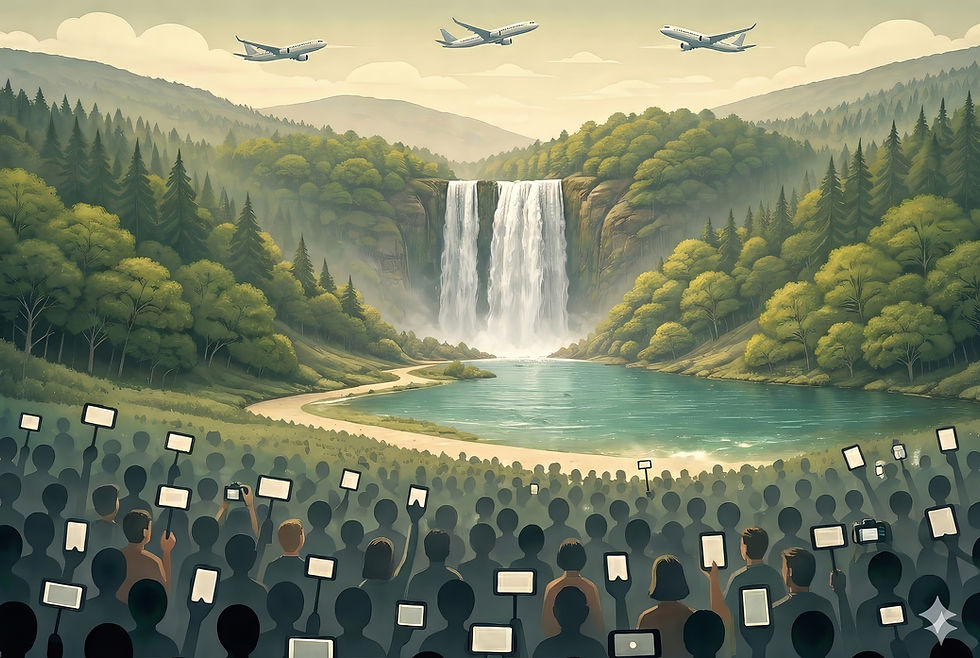
What Is Photohiking?

A neighbour praises a photograph from the Steinerberg — and immediately asks about the camera. This essay is the other answer: a story of frost, late light, and the experience that a landscape is not merely visited but read. Why Photohiking is more than hiking with a camera.
It had been a hard climb to the summit of the Steinerberg above the Ahr valley. But the view I had come for was overgrown. The promised fog lay far off and never came together as an image. The frost that morning was relentless; my fingertips ached.
I waited. Then, disappointed, I started down through the forest. The sun climbed slowly. And then, when I no longer expected it, fog stood between the trees. When I turned and looked back, shafts of light felt their way through the forest towards me. My heart beat faster. I grew warm. I made my photographs.
Later I showed a neighbour the strongest image of the sequence on my phone.
‘Nice,’ he said. ‘But you do have expensive cameras. And I suppose it’s been edited.’
That was when I understood: I did not need to explain the image. I needed to explain the path.

The Path Before the Image
The path does not begin with the image. It begins long before — usually as I leave the house, when the air is different from the day before and the body does not yet know what the morning will ask of it.
On the Steinerberg it was the frost that spoke to me first, before any image was possible at all. The cold forces a pace you do not choose. You walk more carefully, because the body registers every careless step at once. After a while the step changes. It grows steadier, finds its measure. The breath lays its own rhythm over the path; the hands stop searching for warmth. In that moment the landscape is not a backdrop. It is something that responds to me and that I respond to: dampness, slope, wind. Photohiking cannot simply be used as a technique. It is a practice that only takes shape along the way — in the body first, in the mind later.
When the Plan Falls Apart
That morning I nearly gave up. The view I had come for did not exist. And that is part of it: a Photohike rarely delivers what the preparation seemed to promise. The fog did not come where I had expected it. It came later, differently, in the forest, on the way down — when I was no longer counting on it.
Above the Fog The Forest Shelter Water Over Stone Through the Rock The Volcanic Path Evening Above the Town
Six paths, six encounters — none of them planned.
Not Places, but Encounters
I do not photograph places. I photograph encounters.
When I turned and saw the shafts of light reaching for me through the trees, it was not a subject I had found. It was a moment that had found me. I look for states: a fog that is not spectacular but has a certain density. Light that refuses to release the slope, until all at once it relents. An old wall, a ruin, a place that holds the eye. I use the camera only when I sense that a moment will stay.
Seven Images, Not a Best-Of
A morning like this cannot be held in a single image. This is why I work in sequences: seven images as a form that does justice to the path. A beginning that feels its way — the climb, the overgrown view. A middle that carries the waiting and the shift — the descent, the last look before the light arrives. A detail that sharpens the eye — the first thread of light between the trunks. An ending that makes the exhaustion palpable — the walk back, cold, but changed. The sequence is not a best-of selection of the strongest single images. It is the reflection of a path that changed in the light — a small, self-contained cosmos that could only have taken this shape on that particular morning.

What mornings like these become: the Photohike series in the archive.
The Second Trace
Why, then, a text alongside the images? Because there is something the images cannot show: the disappointment at the summit, the aching fingers, the moment I almost turned back without looking round once more. Image and text are two traces of the same experience. They are two different ways of grasping the same path.
Nearness, Not Possession
My paths lie not far from my front door. That is no accident. I work where I live — in the Ahr valley, in the Eifel, along the Moselle and the Rhine. Familiarity changes the way I see. I know the trails that turn treacherous in the sun, the valleys where the cold collects, the places where the wind shifts. This nearness keeps me from consuming the landscape, from ticking off a place as something I have now seen. Instead I meet it again and again, under different conditions, in different light — and each time it shows me something I did not know before.

More Than a Result
When my neighbour spoke of expensive cameras and editing, he probably meant the image as a result. But a Photohike is not a result. It is the path, the frost, the waiting, turning round by chance at the right moment, the unexpected light, the seven images that came of it, and the text that tells what the images cannot show.
A Photohike does not end with the last image. It echoes on, sometimes faintly, sometimes more clearly. Only in that resonance does it become possible to feel what the morning really carried: not the strength of a subject, but the experience that took shape through walking.
Photohiking is a method: the attempt not to possess a landscape, but to meet it.
This essay was first published on 23 July 2025 and was substantially revised and expanded in July 2026.
Discover more
Photohiking means Walking. Seeing. Telling.
To discover more journeys, visit Photohikers
If this essay resonated with you or if you would like to share a thought, feel free to contact me directly by email or via the contact form.
All Photohike image series are available on Flickr.
Selected images are available as fine art prints on Picfair.
Questions or thoughts? Write to lars.roth@wanderspezi.com
© Lars-Henrik Roth / Wanderspezi – The Photohiker.
All texts and images are protected by copyright. Any use without prior permission is prohibited.