

Your Best Shot Might Be 90 Minutes Away

On responsibility, proximity, and a different approach to nature photography
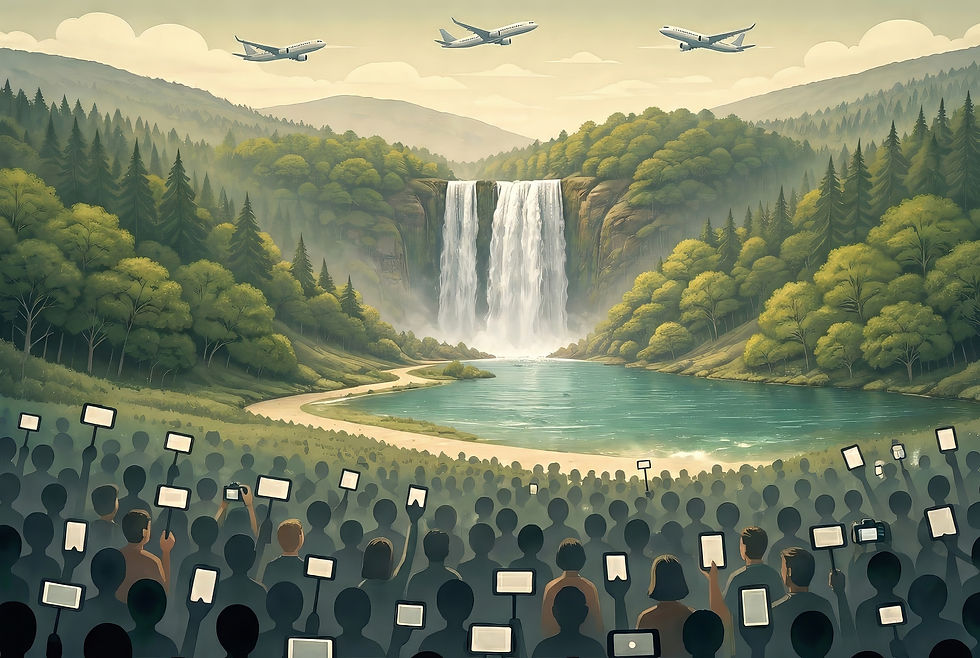
We think we already know certain landscapes long before we ever set foot in them.
Fanal on Madeira. Trolltunga in Norway. The sculpted sandstone of Antelope Canyon. The terraces of Machu Picchu. The skeletal acacias of Namibia’s Deadvlei. Or Mount Fuji rising behind an ordinary supermarket in Fujikawaguchiko— a view that has been repeatedly restricted by barriers erected to manage the crowds.
Their images are everywhere, repeated so often they feel like personal memories. We know the exact angle, the right place to stand, the perspective everyone expects. The place feels familiar before we’ve ever experienced it. When we finally arrive, something strange happens: we’re no longer there for the landscape. We’re there for an image that already existed without us. The eye doesn’t search for the unknown—it simply confirms what we already anticipated. The paths are worn flat not by chance, but by repetition. The ground no longer tells stories of weather or seasons. It only records the sheer accumulation of footsteps.

Much has been written about overtourism—the trampled vegetation, the cordoned-off areas, the noise in places never meant for crowds. Those problems are visible and well documented. What concerns me more, however, is something rarely discussed: the ecological price of the journey itself. What happens long before anyone reaches the spot.
Many nature photographers still travel halfway around the world for a single image. They plan carefully, fly across oceans, hike for hours, wait for the perfect light, then fly home. The love for nature is usually genuine. And yet, over time, a quiet discomfort settled in me—not because of the places themselves, but because of how we choose to reach them.
That tension could not be ignored. It was uncomfortable, but it was real. And it forced me to begin questioning my own practice.

The Blind Spots of Icon Hunting
The problems at famous photography spots are no secret. Fanal had to be protected with kilometers of barriers because the vegetation could no longer survive the constant foot traffic. At Trolltunga, rescue teams pull hundreds of people off the mountain every year—often because they underestimated a demanding trail they only attempted for one photograph. At Kjeragbolten, the scene feels less like nature and more like a ticketed event.
These situations make one thing painfully clear: nature cannot sustain this level of attention.
What almost no one talks about is the price paid before the experience even begins. A single flight to Madeira or Norway can produce more CO₂ than dozens of local photo outings over an entire year. For many images, the largest ecological footprint isn’t the worn path or the trampled moss—it’s the moment a plane leaves the ground.

The longer I thought about it, the more clearly I saw the contradiction. We say we love these places. Yet the way we reach them often contradicts that love. This wasn’t a moral indictment—it was a question I could no longer set aside: Can you truly value a place when visiting it requires accepting significant harm?

When a Spot “Died”: The Morning at Burg Eltz
Sometimes it takes only a quiet moment to shift everything. For me, it happened one morning at Burg Eltz.
I had arrived early. Mist hung in the valley and the light was soft and gentle. For a few precious minutes everything felt still and right. I stood alone on the path, camera ready, feeling like I was truly meeting the place.
Then the first tourist buses arrived. As the mist lifted, a queue formed. Many of the visitors seemed less interested in the landscape around them than in the single angle they already knew from photos. They walked past the very surroundings they had come to see, focused only on reproducing an image. The moment was gone before it had even begun for them.
A couple approached me.
“Oh! A photographer! Please make photo?”
They held out an iPhone. I took it. As they stepped into position, my thumb instinctively moved toward portrait mode. In that small instant—between gesture and habit—something became clear: this wasn’t supposed to be a portrait at all. It was proof of having been there. An image preserving an experience that had never actually happened.
I handed the phone back. The moment dissolved, just like so many others that morning. What remained was a quiet disillusionment—not with the people, but with the way a place can lose its meaning without being visibly destroyed. My own photograph had already been taken. But something else had disappeared: the silence, the openness, the chance to encounter a place without expectation.
That morning I understood that a spot doesn’t die only through overuse. It dies when it becomes an obligation.

The Unconsidered Journey
The paradox runs deeper than most of us acknowledge. We travel out of love for nature and, in doing so, consume it. We seek the extraordinary and choose the very paths that put it at risk. We want images as memories and leave behind traces that last longer than the photographs.
More than a hundred thousand people stand on Trolltunga every year. The place is vast and remarkable—but it was never meant to bear that kind of pressure indefinitely. Fanal grew over centuries; tourism has inflicted damage there in just a few years that will take generations to heal.
These observations didn’t leave me resigned. They left me restless. One question kept returning: What is nature photography worth if it damages the very thing it wants to celebrate?
That question wasn’t the end. It was the beginning of a search for a different approach.

The Principle of Locality: A Different Way In
Slowly, almost without noticing, a new idea took shape. It wasn’t a rigid rule or a finished philosophy—just a shift in perspective. I began to wonder whether there might be another way into landscape photography, one grounded not in sacrifice but in honesty.
For me, locality doesn’t mean seeing less. It means looking more carefully. It means accepting our own limits and treating them not as constraints, but as a frame for seeing. Not every landscape needs to be reachable. But every landscape we do reach deserves our full attention.
In practice, this became a simple rule of thumb: roughly ninety minutes from home. No flights for a single image. No long-distance travel to chase a known perspective. No icon hunting—not out of dogma, but out of consequence. The radius isn’t a law. It’s a compass. It forces choices, and that friction is exactly where the creative power lives.
When distance is no longer an option, the focus changes. I stopped photographing places because they were supposed to be spectacular. I started photographing when light, weather, and atmosphere came together. I no longer chased subjects—I waited for moments. This shift hasn’t narrowed my work. It has opened it. Responsibility and creativity are no longer opposites. They depend on each other.
![Moss-covered forest resembling New Zealand rainforest]](https://static.wixstatic.com/media/c27f63_710d4fb0bcdd42b1a2c11841cfe79ce7~mv2.jpg/v1/fill/w_980,h_653,al_c,q_85,usm_0.66_1.00_0.01,enc_avif,quality_auto/c27f63_710d4fb0bcdd42b1a2c11841cfe79ce7~mv2.jpg)
The Creative Power of Proximity
Working locally means photographing under different conditions. You don’t have the safety net of iconic subjects. Instead you have places that reveal themselves gradually, only as you move through them—places that make no promises and ask for your attention.
One such place is the Ahr Valley near Altenahr. Anyone who goes there sees more than landscape. You see history: the open wounds of the 2021 flood, the slow work of reconstruction, and alongside it, an almost startling romantic beauty—steep cliffs rising above the valley that feel almost alpine in their ruggedness. Not staged, not hyped. Simply there.
Photography here doesn’t happen in spite of proximity. It happens because of it.
You return again and again. The same bend in the trail looks completely different in new light. The same rock face changes with mist, backlight, or winter frost. Familiarity sharpens your eye. You begin to notice details you would have missed on a single visit.
Something similar happened on a photo hike to Saffenburg Castle. No famous landmark, no bucket-list icon—yet a small miracle occurred: a sudden window of light broke through the clouds for just a few minutes. Nothing you could plan. Nothing you could repeat. It happened simply because I was there, because the walk itself was part of the picture, and because time, place, and attention aligned.
Places like these teach patience. They remind you that powerful photographs rarely come from repeating other people’s images. They come from staying with a landscape long enough for it to unfold on its own. Proximity demands real engagement—and that is precisely where its creative strength lies.

The Photohiking Principle: A Way Out of the Dilemma
Out of this approach, what I call photohiking has become central to my work—a practice less about technique than about a way of seeing. At its heart is one simple idea: the path matters more than the destination.
When you walk before you photograph, your eye stops fixating on the endpoint. It opens to everything in between—the shifts in light, the changes in sound, the small transitions of weather, season, and mood. Many of these impressions never make it into anyone’s image archive because they can’t be repeated. They exist only in the moment, and only for the person who was present.
Photohiking leads naturally to a more individual photographic voice—not by trying to be different, but by letting go of templates. Images arise from lived experience rather than expectation. From presence instead of anticipation.
This is not a moral claim and not a call for abstinence. It is an invitation to reconsider one’s own path. Not to go further—but more deliberately.
For me, photohiking has become a quiet counterpoint to much of what has grown loud in nature photography: the hunt for spots, the idea of nature as backdrop, and sometimes—if we’re honest—a kind of self-interest dressed up as passion.
The Future of Nature Photography Begins at the Door
The ethical footprint of a photograph doesn’t end at the edge of the frame. It begins long before—with the decision of how we choose to get there and the traces we leave even before the shutter is pressed.
Nature photography is usually discussed in terms of subjects, locations, and final images. Rarely in terms of the journey. Yet the journey carries most of the responsibility. Long-distance travel for a single photograph becomes harder to justify the closer you look—not because travel itself is wrong, but because it has too often become automatic. We have mistaken distance for significance.
The longer I photograph, the clearer this becomes: the future of nature photography does not lie in ever more spectacular places. It lies in a different mindset. In a return to proximity, to attention, to time. It is quieter, less efficient, less focused on comparison. And for exactly those reasons, more honest.
The most powerful images rarely appear where crowds gather. They appear where someone is traveling on foot. Where light is not expected but observed. Where a moment doesn’t need to displace anyone else in order to exist.
When photography becomes encounter rather than extraction, its value changes—not only aesthetically, but ethically. The image then shows not only a landscape, but the respect with which it was approached.
Perhaps the most important question in nature photography is no longer how far we are willing to go.
It is how close we are willing to get.
With our feet. With our time. With our attention.
Because true seeing begins where proximity is not exploited, but allowed.
This essay is a substantially revised English author's version of a text first published on this site in November 2025. A German version was later published by Nature First in January 2026.

As a member of Nature First — Alliance for Responsible Nature Photography, I choose to align creativity with responsibility. If we truly love the landscapes we photograph, then the way we reach them matters as much as how we frame them.
🔗 Discover more
Photohiking means Walking. Seeing. Telling.
To discover more journeys, visit photohikers.de.
✉️ If this essay resonated with you or if you would like to share a thought, feel free to contact me directly by email or via the contact form.
➡️ All Photohike image series are available on Flickr.
➡️ Selected images are available as fine art prints on Picfair.
Questions or thoughts? Write to lars.roth@wanderspezi.com
© Lars-Henrik Roth / Wanderspezi – The Photohiker.
All texts and images are protected by copyright. Any use without prior permission is prohibited.


