Beyond the Visible: The Triad of Photohiking

About images that only emerge while walking — and words that reveal what images leave unspoken. By Lars-Henrik Roth.
There is a moment on every photohike when I stop searching. Not because I have found what I was looking for, but because I have forgotten what that was. My steps slow down. My breathing settles. And suddenly, something is there that wants to be seen.
That is the moment I photograph.

I am a photographer, a walker, and a storyteller. These three threads existed separately in my life for a long time — an early sensitivity to light and pictorial space, solitary, rhythmic walks through landscape, and handwritten stories for individual people, never for an audience. Photohiking is the moment when all three converge. It is neither a technique nor a genre. It is an attitude — and a consequence.
What emerges when you walk
My photographic decisions emerge while walking, pausing, walking on. Not at a desk, not in front of a screen, not at a spot a thousand others have already photographed. The path is not a means to an end — it is part of the image. What I see, I owe to the route, sometimes to the detour. What emerges cannot be planned. And that is precisely where its value lies.
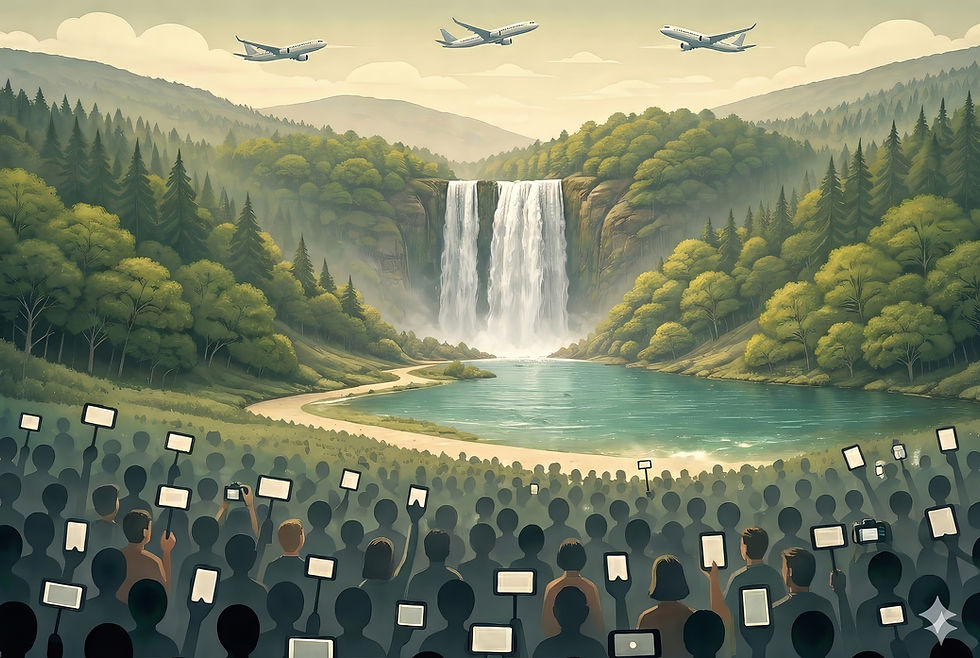
Out of conviction, my work emerges predominantly within a 90-minute radius of my home near Cologne. The cultural landscape of the Rhineland, the Eifel, the Moselle, and the Ahr Valley holds more light, more transitions, more photographic truth than any iconic spot I could reach by plane — a place that would then be expected to deliver, and might not.
Proximity sharpens the eye. Familiarity opens seeing.

Light as Protagonist
I do not photograph places. I photograph light events: the fog that lifts and lets a castle emerge like an island from the white. The light that breaks through clouds for a few minutes and transforms a vineyard into something no brush could invent. The frost that turns a moorland into an etching — and the withheld light that forces me to think in black and white, in lines rather than colours, in Ma (間) rather than abundance.
Light is not an effect in my work. It is the protagonist. The landscape becomes its field of resonance.

The Series as Form
I work serially. Always seven images. This is not a convention — it is a decision. Seven images are enough to build a narrative. Too few for a highlight reel, too many for a single image. But exactly right for what I want to show: a process, a perception, a morning in all its ambivalence.
Every series has a narrative architecture, like the movements of a musical composition, like the acts of a drama. An opener that invites and sets the stage. A conceptual centrepiece that carries the core — a concentrated image that does not immediately reveal everything, but unfolds its full depth and meaning only in dialogue with the essay. A detail that grounds: red berries in frost, a grape in the last light, a boulder in the foreground that says, “I was here. I reached this on foot.” And a closing image that opens the gaze again and restores the silence.
This structure is shaped by an inner tension: as in a musical piece, there is theme, variation, intensification, and resolution. The seven images are not a collection of moments — they are a single, coherent argument.
A single image can be beautiful. A series can carry meaning.
The Photohike Essay as Third Dimension
Every series is accompanied by a Photohike Essay. Not as explanation, not as caption, not as trail description — but as the third dimension of the work. The essay describes what came before the first image: the idea that emerged on a winter evening between the pages of an old book. The decision to climb again, even when I had already decided to turn back. The moment when the light refused — and what that refusal made visible.
At a time when photographic images are increasingly met with suspicion about their authenticity, this act of telling takes on an added significance. It is not proof in any technical sense, and not a justification. But it carries the trace of real passage through the world: time, body, hesitation, decision, perception. The text does not explain the image. It bears indirect witness to the experience from which the image emerged. And therein lies a new artistic necessity: not because the image would be weak without words, but because words complete the circle of perception that the image alone must leave open.
Image and text form an inseparable symbiosis — like score and performance. The series shows what was. The essay carries what it means — and preserves the human trace of its making. Those who see only the images experience one third. Those who read images and text together begin to understand what photohiking is: a path that does not end when the shutter is released.
For an exhibition, this is essential: a series of mine is not a collection of prints. It is a complete work — image, sequence, and text as three inseparable voices.

The Triad
Photohiking rests on three inseparable dimensions: walking as the space of emergence, the series as form, and the essay as bearer of meaning and an anchor in lived experience. Only in their interplay does the work come into being. Walking generates perception, the series organises that perception into a visual dramaturgy, and the essay opens a space for meaning — not as explanation, but as depth and as a human trace.
Remove one of these dimensions and what remains is a fragment: an image without a path remains a motif; a series without text becomes a sequence; a text without images becomes mere assertion. Photohiking is the conscious decision not to separate these three voices.
An Attitude, Not a Compromise
I do not photograph to the rhythm of a market — I photograph to the rhythm of a path. This is not a limitation, but a freedom: I publish only when there is something to say. No images for algorithms, no posts optimised for reach. Instead, I develop series that resist fleeting consumption — like the light in the moor that appears only when you have stayed long enough.
Photohiking, as a consciously described and lived method, is the antithesis of fast content production. No spot-hopping, no chasing the algorithm, no image made only for the moment. Photohiking is slow, local — and deliberately set against the ecological cost of spectacle. It is for the landscape at one’s doorstep, for the moment that cannot be reproduced, for the image that only comes into being because someone was on foot and willing to wait.
The strongest image does not stand where everyone stands. It waits elsewhere.
Winter 2026
🔗 Discover more
Photohiking means Walking. Seeing. Telling.
To discover more journeys, visit photohikers.de.
✉️ If this essay resonated with you or if you would like to share a thought, feel free to contact me directly by email or via the contact form.
➡️ All Photohike image series are available on Flickr.
➡️ Selected images are available as fine art prints on Picfair.
Questions or thoughts? Write to lars.roth@wanderspezi.com
© Lars-Henrik Roth / Wanderspezi – The Photohiker.
All texts and images are protected by copyright. Any use without prior permission is prohibited.